
Steppe Hypothesis

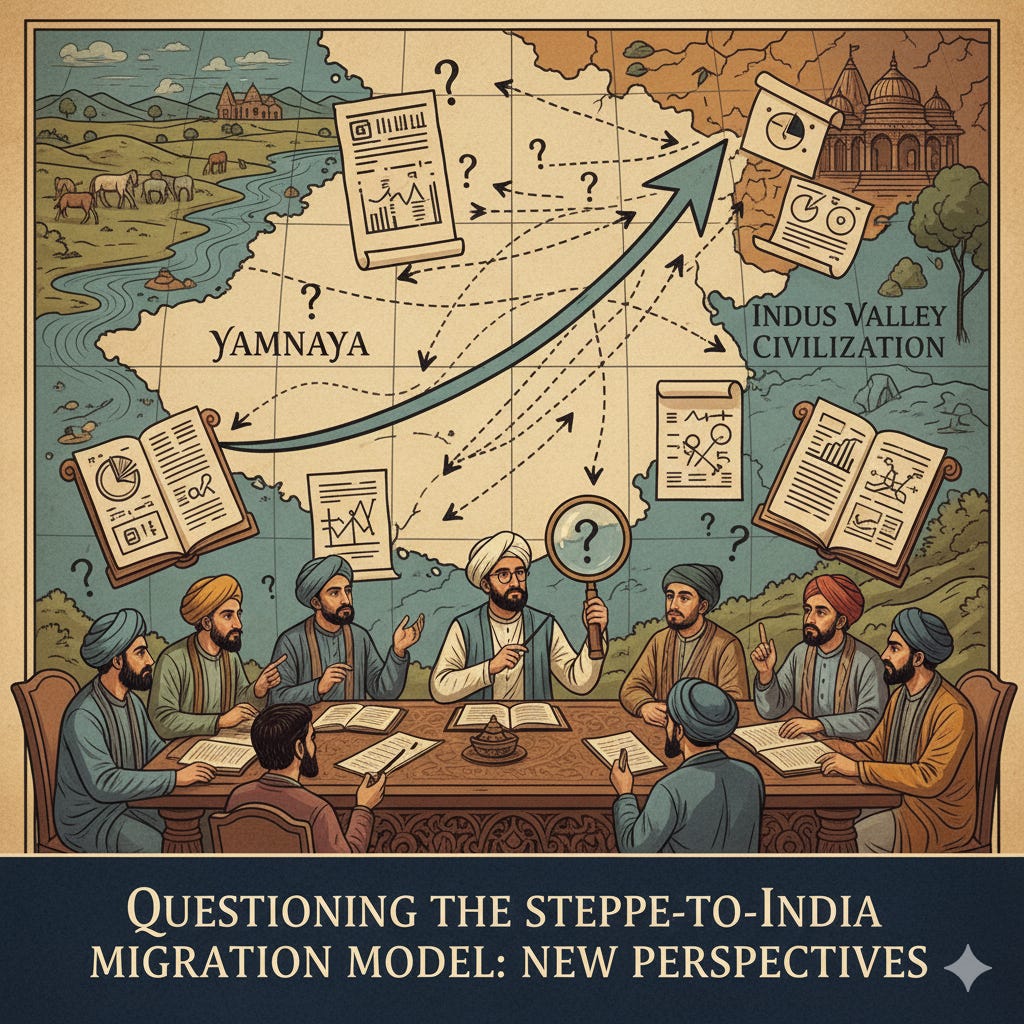
Several scholars, papers and discussions that critique or question the idea that the Yamnaya culture (steppe-pastoralist group from north of the Black Sea) migrated directly into India (or that their descendants did so) in the way popular models sometimes present.
✅ Key critiques / critical voices
The article “Something is very wrong with models based on the so-called ‘steppe admixture’ — and archaeologists are catching up” outlines how some archaeologists (not geneticists) argue that applying the Yamnaya → India model wholesale is problematic, because language, culture and genes need not map cleanly. Indo-European.eu
A paper in European Journal of Archaeology (“Discussion: Are the Origins of Indo-European Languages Explained by the Migration of the Yamnaya Culture to the West?”) features Leo S. Klejn critiquing claims that Yamnaya migrations explain all Indo-European spread — and by implication, the Indian branch as well. Cambridge University Press & Assessment
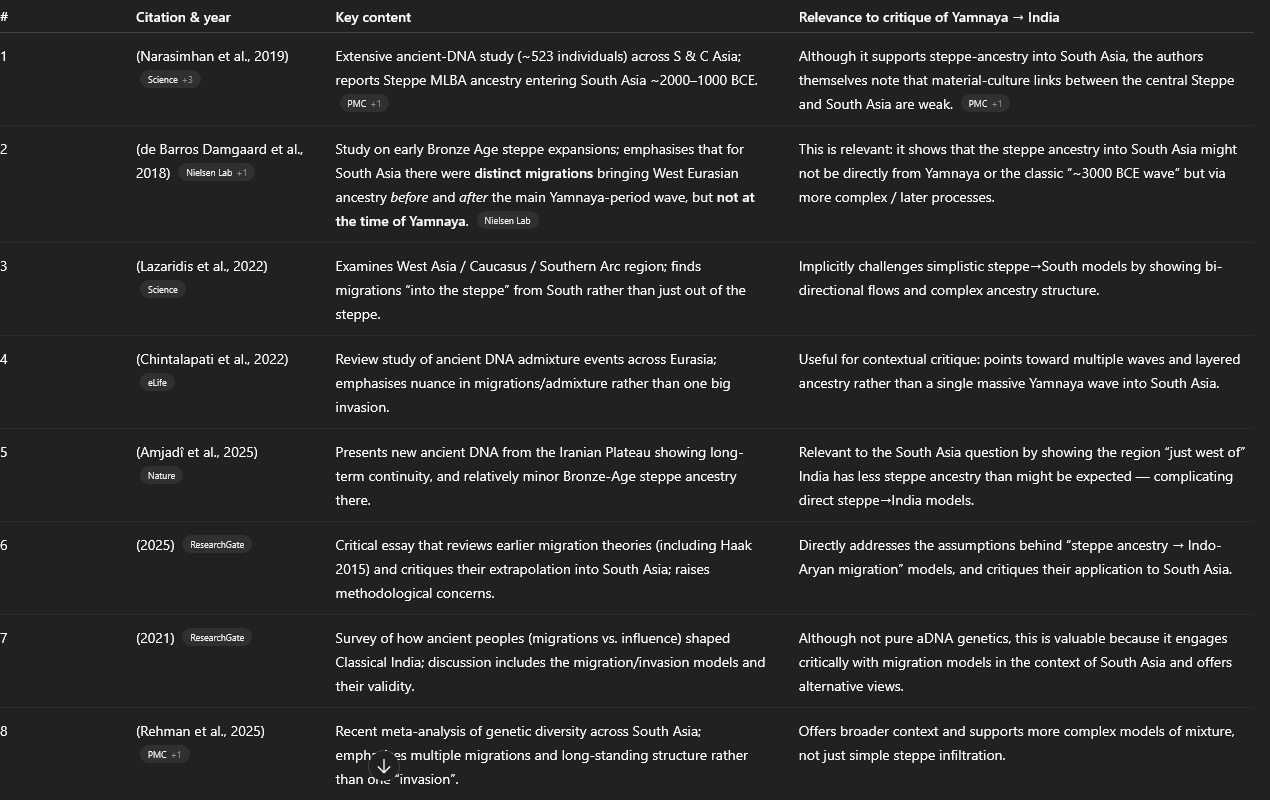
In “The first horse herders and the impact of early Bronze Age steppe expansions into Asia” (2018), the authors report: “We show … distinct migrations bringing West Eurasian ancestry into South Asia before and after, but not at the time of Yamnaya culture.” PubMed
A critique article on IndiaFacts argues that some geneticists over-interpret the linkage of Yamnaya + language, and that archaeological logic is weaker in South Asia than in Europe. IndiaFacts
🎯 What are the main points of concern?
That the Yamnaya gene-signature (or steppe ancestry) found in South Asia is not clearly traceable in time/space as a direct Yamnaya → India wave. For example, paper cited above states there is “no evidence of steppe ancestry in Bronze Age Anatolia from when Indo-European languages are attested there.” PubMed+1
That language shift, cultural transmission, and gene flow need not all align. Genes might move, languages might diffuse without large population movement, etc. Indo-European.eu+1
That the archeological markers of a large steppe‐population intrusion into the Indian subcontinent are weak compared to Europe. Some sceptics note the absence of clear mass-migration signatures in the material culture in India that correspond exactly to Yamnaya or similar groups. Reddit+1
That the steppe ancestry exists in India, but the source, pathway, timing, and cultural/linguistic link remain contested. Eg., not necessarily direct from Yamnaya; might come via intermediary groups/southern routes. ResearchGate+1
🔍 Some specific writers / proponents
Leo S. Klejn — Raise questions about how genetic models are applied to linguistic/cultural history. Cambridge University Press & Assessment
Koenraad Elst — Supports the “Out-of-India” or Indigenous‐Aryan hypothesis and criticises the steppe→India model. Wikipedia
Subhash Kak — Another voice for Indigenous Aryanism; criticised for methods and conclusions by mainstream scholars. Wikipedia
🧮 What this means for the broader theory
The mainstream “steppe hypothesis” (that the Yamnaya or steppe groups carried Indo-European languages outwards) remains popular in Europe & some genetic studies. But when applied to South Asia, many details are uncertain or contested.
The idea of a direct, massive Yamnaya movement into India, replaced/overwriting populations, is strongly questioned. Some models suggest slow migration, cultural diffusion, or involvement of intermediary populations rather than a single big wave.
The relationship between steppe ancestry and Indo-Aryan language arrival in South Asia is not perfectly resolved — there is steppe ancestry, but its path, magnitude, and role in language change are still under study.
🔍 Some notes & caveats:
Even in studies that do find steppe-related ancestry in South Asia (e.g., Narasimhan 2019), the source isn’t always directly Yamnaya or a simple wave from the Pontic-Caspian steppe — many authors emphasise intermediary populations, later migrations, and diffused cultural/ linguistic transmission.
The genetic signal of “Yamnaya-type” (or more generally steppe-derived) ancestry in South Asia is substantially lower than in Europe; many South Asian groups show a mixture of indigenous AASI (Ancient Ancestral South Indian), Iranian-farmer-related ancestry, and steppe ancestry. PMC+1
Material culture/archaeological evidence for a big mass-migration from the steppe into South Asia is weak or ambiguous; for example, Narasimhan et al. state: “material culture differences are so substantial that some archaeologists recognise no evidence of a connection.” PMC
It remains difficult to tie language spread (e.g., Indo-Aryan) to genetic migration with certainty — and many of the critiques stress this point. Genetics shows ancestry flow; it does not directly show language movement.
Many of the more critical pieces are not purely genetic/aDNA but take interdisciplinary approaches (archaeology, linguistics, critical theory) to push back against overly simple “steppe invasion” models.